Industry and government leaders identify what Canada needs to commercialize innovation, scale companies and compete in the emerging bioeconomy.
On September 23, 2026, Genome Canada and partners convened industry, government and research leaders to examine how Canada can strengthen its bio-industrial capacity. Co-chaired by Parliamentary Secretary Karim Bardeesy and Genome Canada President and CEO Rob Annan, the discussion focused on the conditions needed to scale genomics innovation and industry growth in Canada. Hosted in partnership with the Canadian Genomics Strategy Secretariat and Health Emergency Readiness Canada at Innovation, Science and Economic Development Canada (ISED), BIOTECanada and The Dais.
Explore key insights from the roundtable below, developed with support from The Dais.
Key insights for future action
Industry Roundtable on Canada's Bioindustrial Future (September 2026)
Strategic context
Canada has world-class genomics research, significant data assets and applications spanning health, agriculture, natural resources, environmental monitoring and biosecurity. Advances in genomics and AI are increasingly transforming how established industries operate, turning biological data into practical tools that can improve health, strengthen food and biosecurity, increase productivity, support more sustainable resource development and monitor ecosystems.
In today’s economic and geopolitical environment, these capabilities make genomics a strategic national asset that can strengthen sovereignty, drive industrial growth and diversify trade.
Important foundations are already in place. The Canadian Genomics Strategy targets commercialization, data accessibility and talent. Genome Canada is building strategic data assets through initiatives such as the Canadian Precision Health Initiative, which will create Canada’s largest collection of human genomic data designed for responsible use and real-world impact, reflecting the country’s population diversity. It is also investing in industry-academic R&D partnerships and mission-driven innovation across sectors. Meanwhile, broader federal strategies are placing greater emphasis on life sciences capacity and dual-use technologies as pillars of prosperity and resilience.
Canada’s opportunity today is to turn this momentum into industrial advantage: connecting research, infrastructure, capital and domestic demand to translate Canadian data, discoveries and intellectual property into products, companies and strategic capabilities that transform Canadian industries, scale here and compete globally.
Canada needs to build for the full value chain
Canada supports strong research but lacks a sufficiently connected pathway from discovery to production, adoption and scale. In some cases, the challenge is not only capacity but the ability to connect companies and researchers to existing resources. Companies may expand abroad when the facilities and capabilities they need are more accessible or affordable.
Opportunity for action: Increase public policy focus on the full pathway from research to adoption, including better access to existing capabilities and flexible shared infrastructure where new capacity is needed.
Commercialization requires customers, not only capital
Access to financing remains a constraint, but capital alone will not create globally competitive companies. Participants emphasized the difficulty of securing early customers, particularly when Canadian organizations are reluctant to test or adopt domestic technologies. Programs that reduce the risk to customers can accelerate adoption and create the validation companies need to scale.
Opportunity for action: Strengthen commercialization by using procurement, demonstration opportunities and adoption incentives to create a stronger domestic market for Canadian innovation.
Capital gaps exist across the growth continuum
Participants identified financing gaps across the company growth continuum, rather than at a single stage. Early-stage companies need local investors with the risk tolerance and sector knowledge to back emerging technologies, while later-stage genomics companies can require increasingly large pools of capital as they scale. Limited access to either can push Canadian companies to seek investment and growth opportunities elsewhere.
Opportunity for action: Explore a more deliberate financing continuum for genomics companies and cultivate long-term investment relationships—such as those in Europe and Asia—alongside access to US capital.
Data is an underused strategic asset
Canadian companies and research programs are generating substantial genomic data, but its value is not being fully realized. Participants highlighted opportunities to use federated approaches, stronger analytical capacity and shared platforms to translate data into discoveries, products and services while maintaining appropriate control.
Opportunity for action: Greater coordination of genomic data assets and governance to Canadian leadership in AI-enabled biology, rare disease diagnosis and other high-value applications.
IP and institutional incentives shape what gets commercialized
Commercialization can slow when IP negotiations are complex or institutional incentives are not aligned with translation and adoption. Participants pointed to more permissive IP models, clear ownership and strong requirements to work with end users as factors that can help research move into practice.
Opportunity for action: Policy should reward translation and adoption alongside research excellence and make it easier for researchers and companies to establish workable partnerships.
Entrepreneurship is an ecosystem capability
Founders need more than funding. They need networks, experienced guidance, infrastructure and a community willing to support informed risk-taking. Participants described the Canadian ecosystem as fragmented and emphasized the importance of backing risk-takers before outcomes are certain rather than concentrating support on established winners.
Opportunity for action: Canada should make entrepreneurship a deliberate capability by connecting founders, experienced operators, investors, customers and research institutions.
Genomics can transform sectors where Canada already has strengths
The discussion identified Canadian success in therapeutics, rare disease diagnosis, agriculture, biodiversity monitoring, port security and environmental applications. These examples show that the economic opportunity extends beyond building genomics companies. Genomics can be a platform for transformation across established Canadian industries, improving productivity, resilience and competitiveness.
Opportunity for action: Canada should concentrate where it has the strongest scientific, industrial and natural advantages, including agriculture, oceans, natural resources, health and environmental monitoring. This focus can build globally competitive capabilities and accelerate genomics adoption in strategically important sectors.
Implications for policy
The discussion points to five priorities for further exploration:
- Build the pathway from research to industrial impact, connecting research funding to infrastructure, scale-up, manufacturing, adoption and export growth.
- Create stronger domestic demand, using procurement, demonstrations and customer de-risking to accelerate adoption of Canadian technologies.
- Develop stage-appropriate capital, strengthening early Canadian investment while building access to larger pools of growth capital in multiple markets.
- Unlock the value of Canadian data and IP, supporting secure and responsibly governed data use, clearer commercialization pathways and stronger incentives for translation.
- Invest in entrepreneurial capacity, connecting founders to experienced talent, customers, infrastructure and peer networks.
Bottom line
Canada has the research, data and sector strengths to lead in the emerging bioeconomy. The task now is to build the connected industrial system that turns those strengths into greater productivity and competitiveness across Canadian industries, while keeping Canadian intellectual property, companies and economic value growing here.
New data and insights on genomics and Canada's economy
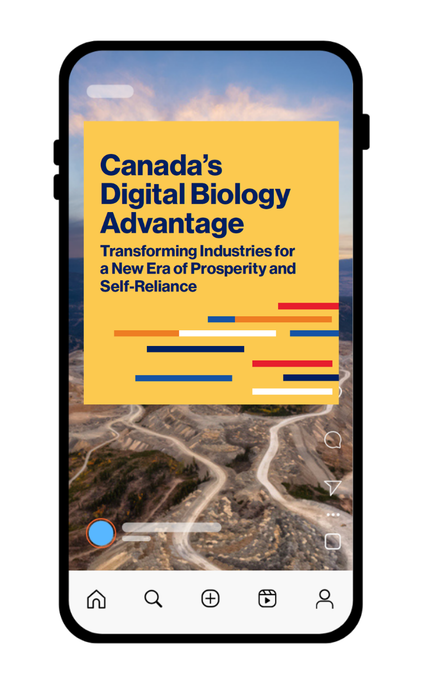
Building on brand-new data from Signal49 Research, our new white paper, Canada’s Digital Biology Advantage: Transforming Industries for a New Era of Prosperity and Self-Reliance examines how genomics is shaping the future of Canadian industries and strengthening the foundations of long-term prosperity, resilience and self-reliance.